Guitar amp
Tweed 59
A late-'50s tweed combo and an early-'60s tube spring reverb, modeled down to every tube, resistor and capacitor, with the same tuner, pedalboard and studio rack as Crumble and Hot Toddy.
$12$20launch price
Mac · Audio Unit, VST3 and a stand-alone app · Apple Silicon and Intel · macOS 11 or later. One license works on up to 3 computers.
Version 1.3.0 · What’s new
Also in the Amp Bundle ($30, with Amps, Crumble, Hot Toddy and Boutique 20) and the All plug-ins bundle ($40).
Three knobs and four jacks
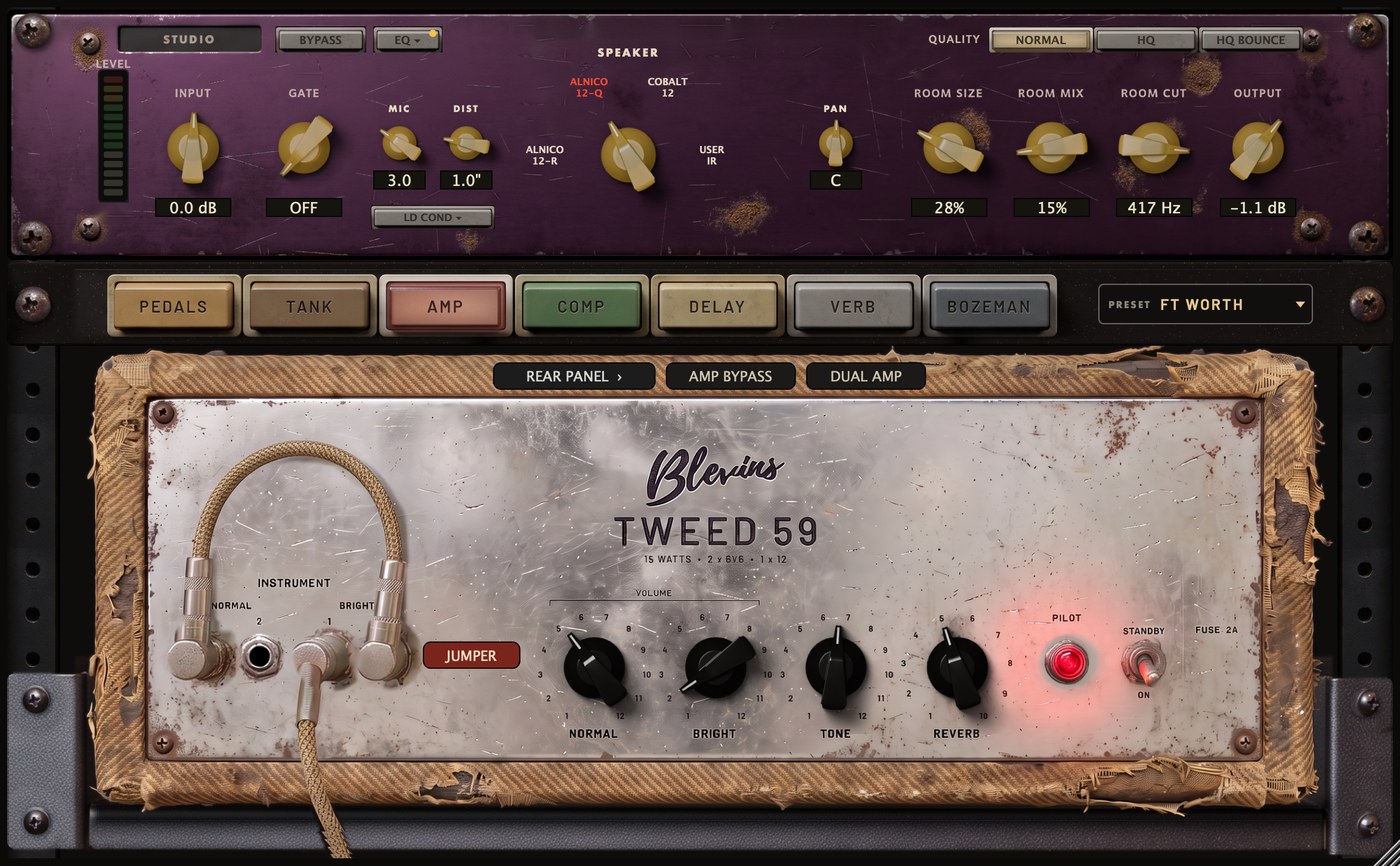
Tweed 59 is modeled on the late-'50s narrow-panel tweed 1x12: 15 watts from two 6V6s, a tube rectifier, no negative feedback, and just three knobs. It cleans up when you play softly, breaks up by 4, and by 9 it's a thick, singing, sagging roar. Which of the four input jacks you plug into matters as much as the knobs, and you can jumper the two channels together the way players always have.
Unlike our other amps, this one is a component-level model. Every tube, resistor, capacitor and pot, the rectifier and power supply, the output transformer and the speaker's load are solved as one circuit, sample by sample, so the channels interact, the supply sags and blooms, and when you dig in hard at full volume the amp caves in and swells back, just like the real thing.
Around the back is a separate early-'60s three-tube spring-reverb unit, modeled the same way: its own driver tube, a long two-spring tank and a recovery stage, with Dwell, Mix and Tone. There's a Reverb knob on the front panel too.
What's inside
Four inputs, two channels
Normal and Bright, each with a high and a low jack, and a JUMPER to run both channels at once. Their volumes interact, as on the original.
Component-level amp
Preamp, cathodyne phase inverter, two 6V6s, the output transformer and a tube-rectified supply, all solved together from the original component values.
Tube spring-reverb unit
A three-tube reverb box between the guitar and the amp, from soft halo to dripping surf, with a 6K6 or 6V6 driver and a Kick the Tank button.
Swap the tubes
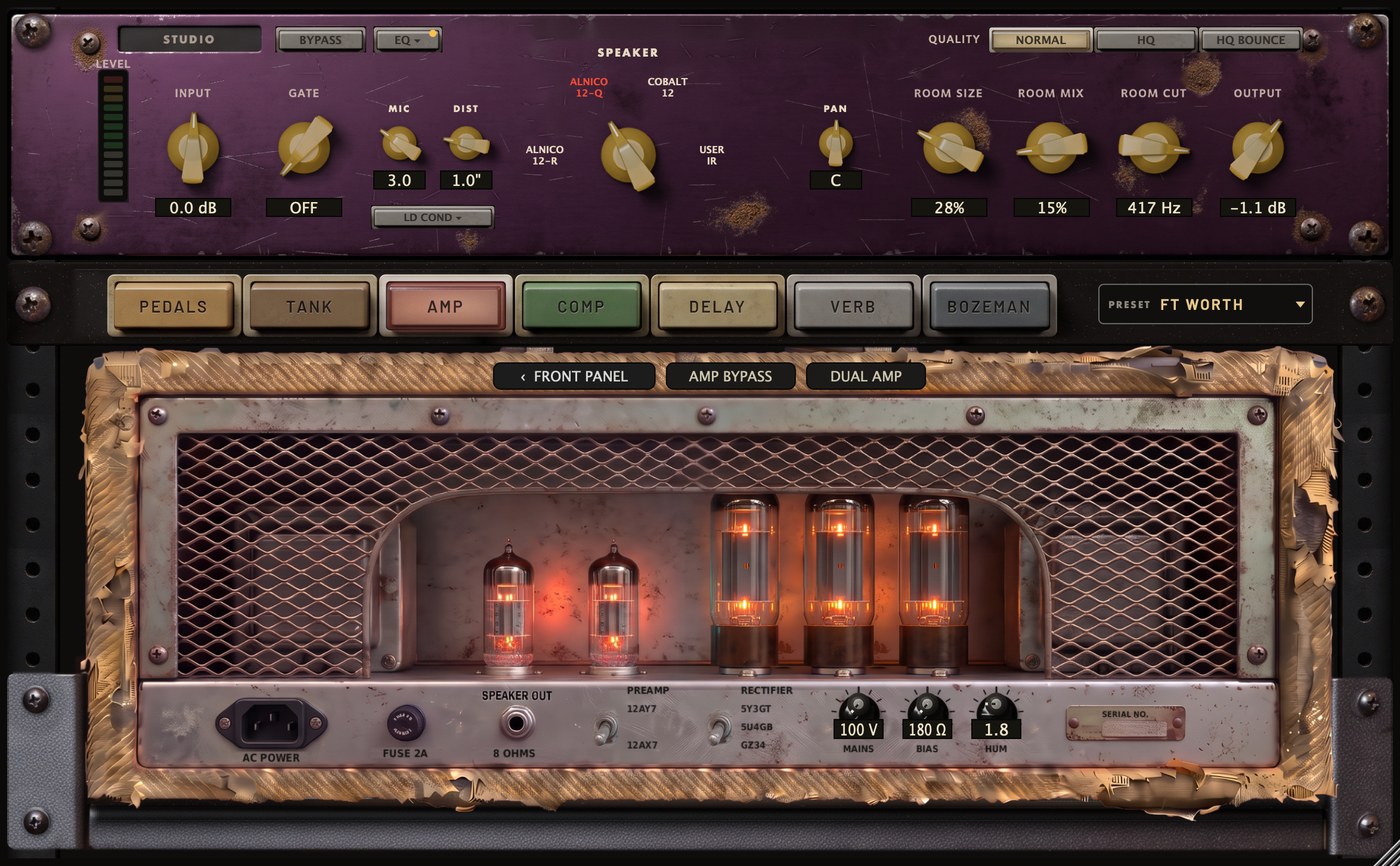
Choose the preamp tube and the rectifier, set the mains voltage and the bias, and turn the hum up or all the way off.
Three speakers
Two vintage alnico 12s and a British-style alnico upgrade, each a physical model that loads the amp, in an open-back pine cabinet. Or load your own impulse response.
Pedalboard and tuner
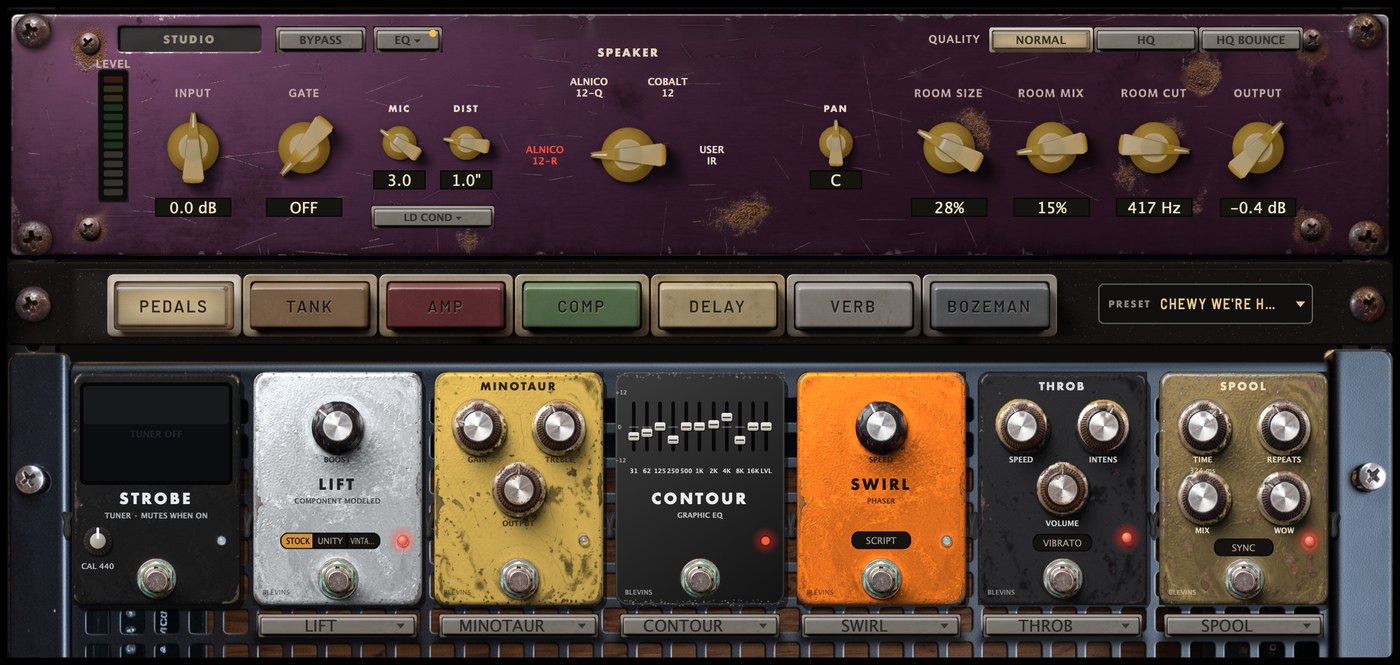
A strobe tuner, then six pedal slots you can fill and reorder: drives, fuzz, compression, modulation, delay, octave, swell and EQ.
Studio strip
Input, gate, speaker and mic position, a room, pan and output.
Dual amp
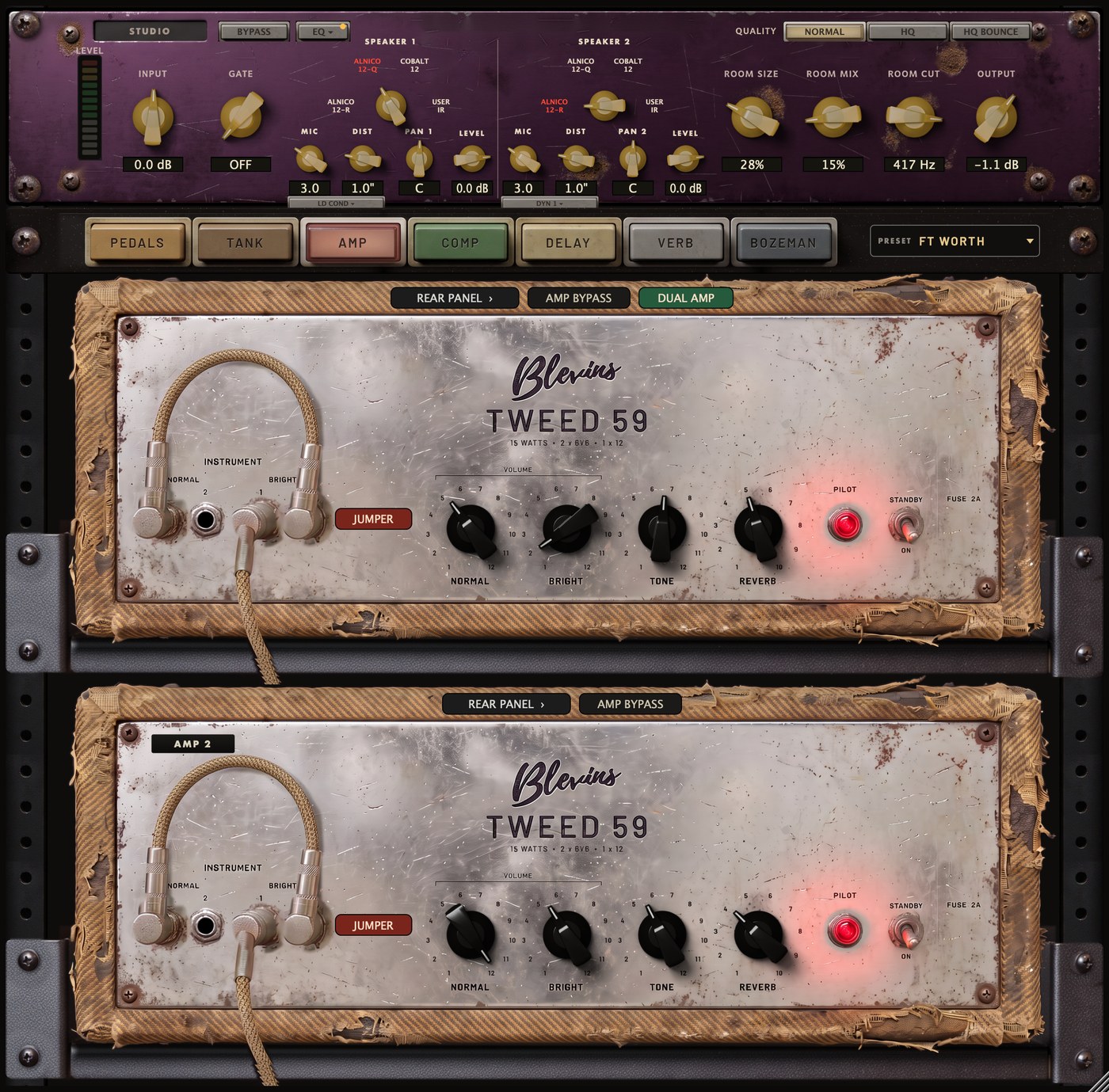
Run a second, fully independent Tweed 59, with its own reverb unit, from the same pedalboard.
Leveling amp, delay and reverbs
An optical leveling amp, a stereo studio delay, a studio reverb, the dual-engine Bozeman reverb and a tube-style program EQ.
A closer look
Specs
- Formats
- Audio Unit and VST3, plus the stand-alone Tweed 59 app for playing without a recording app
- System
- macOS 11 or later, Apple Silicon and Intel
- License
- Up to 3 computers, works offline after activation
Try it free for 14 days
Download the Blevins Tone Co. installer, tick Tweed 59 (or all of them), then open Tweed 59 in your music app and click Activate online. Every feature works during the trial.